The 12 Bhavas of Vedic Astrology
Master the houses of your birth chart. Discover where cosmic energies manifest in your life through the ancient wisdom of Jyotish.
Calculate Your Houses FreeWhat are the 12 Houses?
Houses (Bhavas) are 12 divisions of your birth chart representing different life areas - from self and wealth to career and liberation.
Determined by: Your Ascendant (Lagna) - the sign rising at your exact birth moment and location.
Purpose: They reveal where planetary energies manifest in your specific life experiences.
What Are Houses in Vedic Astrology?
The word Bhava in Sanskrit means "state of being" or "condition of existence." Each of the 12 houses represents a specific domain of human experience - from self and family to career and spiritual liberation.
According to Brihat Parashara Hora Shastra (BPHS), the foundational text of Vedic astrology, the houses are described as the "fields" where the fruits of karma ripen. Maharishi Parashara teaches that understanding the houses is essential for predicting life events and understanding one's purpose.
Key Principles of House Analysis
- House Lord: The planet ruling the sign in a house - its placement shows where that house's themes manifest
- Occupants: Planets sitting in a house directly influence its significations
- Aspects: Planets casting aspects (drishti) on a house modify its results
- Karaka: Each house has a natural significator planet that supports its themes
Houses vs. Signs: The Key Difference
One of the most common points of confusion for astrology students is distinguishing between houses and signs. While both use a twelve-fold division, they serve entirely different purposes.
Signs (Rashis)
- Fixed divisions of the zodiac (30° each)
- Describe qualities and characteristics
- Same for everyone born on the same day
- Based on the Sun's annual path
Houses (Bhavas)
- Based on your specific birth time & location
- Represent areas of life experience
- Unique to each individual (changes every ~2 hours)
- Based on Earth's daily rotation
Example: Two people born on the same day will have planets in the same signs. But if one was born at dawn and one at noon, their house placements will differ significantly. The dawn-born person might have Sun in the 1st house (prominent self-expression), while the noon-born person has Sun in the 10th house (career prominence).
How Houses Are Calculated
In Vedic astrology, the Lagna (Ascendant) is the zodiac sign rising on the eastern horizon at the exact moment and location of birth. This Lagna becomes the starting point - the 1st house cusp - and all other houses follow in sequence.
The Calculation Process
- Determine the Ascendant: Calculate which sign was rising at birth time and location
- Assign the 1st House: The entire sign containing the Ascendant becomes the 1st house
- Number Subsequent Houses: Each following sign becomes the next house (2nd, 3rd, etc.)
- Complete the Circle: The 12 houses span all 12 signs, returning to where you started
Why Birth Time Matters: The Lagna changes approximately every 2 hours (some signs rise faster than others depending on latitude). A birth time error of just 4 minutes can potentially shift the Ascendant to a different sign, completely changing the house structure.
See Your Ascendant & House Placements
Discover your Lagna and which planets occupy each house in your personal chart.
Calculate My Lagna NowFree • Accurate sidereal calculations • Instant results
North Indian vs South Indian Chart Formats
The first step in learning how to read a Vedic birth chart (kundli) is knowing which format you are looking at. Open two charts for the same birth and they can look nothing alike — one a diamond, the other a square grid. Both hold the identical planetary placements; they differ only in drawing convention.
North Indian (diamond — houses are fixed)
The chart is a diamond, and the 12 houses stay in fixed positions. The 1st house (Lagna/Ascendant) is always the top-centre segment; houses 2, 3, 4… follow counter-clockwise. It is the signs (rashis) that move — a small number in each house tells you which sign it holds. To find the Lagna: look at the top-centre diamond, read it as house 1, then move counter-clockwise.
South Indian (square grid — signs are fixed)
A 4×4 grid with a blank 2×2 centre. Here the 12 signs stay in fixed boxes (Pisces top-left, then Aries, Taurus, Gemini across the top, proceeding clockwise), and it is the houses that rotate with your Lagna. The Ascendant box is marked — often a diagonal line or “As”/“Lagna”. To find the Lagna: locate the marked Ascendant box; that sign becomes house 1, then count houses clockwise.
| Feature | North Indian | South Indian |
|---|---|---|
| Shape | Diamond | Square grid (blank centre) |
| What stays fixed | The 12 houses | The 12 signs |
| What rotates | The signs (rashis) | The houses |
| Where the Lagna sits | Always the top-centre segment | Whichever box is marked “As”/Lagna |
| Reading direction | Counter-clockwise | Clockwise |
The one-line takeaway: North Indian keeps the houses fixed and moves the signs; South Indian keeps the signs fixed and moves the houses. Same chart, two conventions — generate your own chart and read your Lagna in either format.
House Classifications
Classical Vedic texts classify houses into distinct categories based on their nature and effects. Understanding these classifications is crucial for chart interpretation.
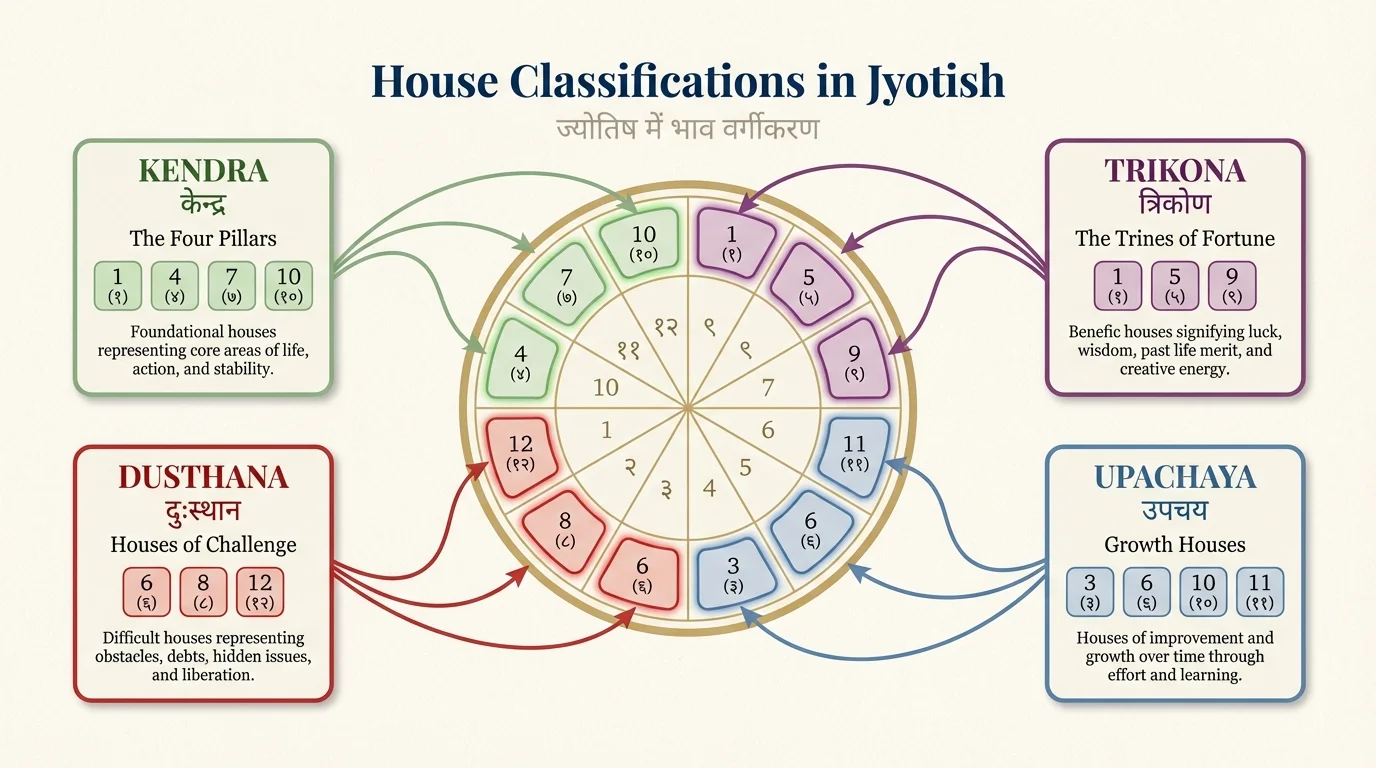
Kendra Houses
Angular Houses - "The Four Pillars"
The most visible and powerful positions. Planets in Kendras gain strength and manifest prominently in life.
Trikona Houses
Trinal Houses - "Houses of Fortune"
The most auspicious houses representing dharma, past merit, and fortune. Benefics here give excellent results.
Dusthana Houses
Challenging Houses - "Houses of Growth Through Struggle"
Houses of challenge and transformation. Malefics can actually perform well here - Mars in 6th defeats enemies.
Upachaya Houses
Growth Houses - "Improvement Over Time"
Results improve with age. Malefic planets (Sun, Mars, Saturn, Rahu, Ketu) perform especially well here.
Maraka Houses
Death-Inflicting Houses - "For Longevity Analysis"
Examined in longevity analysis. Effects only activate during specific dasha periods with multiple confirming factors.
The 12 Houses: Complete Guide
Below is a comprehensive analysis of each house according to classical Vedic texts, particularly Brihat Parashara Hora Shastra, Jataka Parijata, and Phaladeepika.
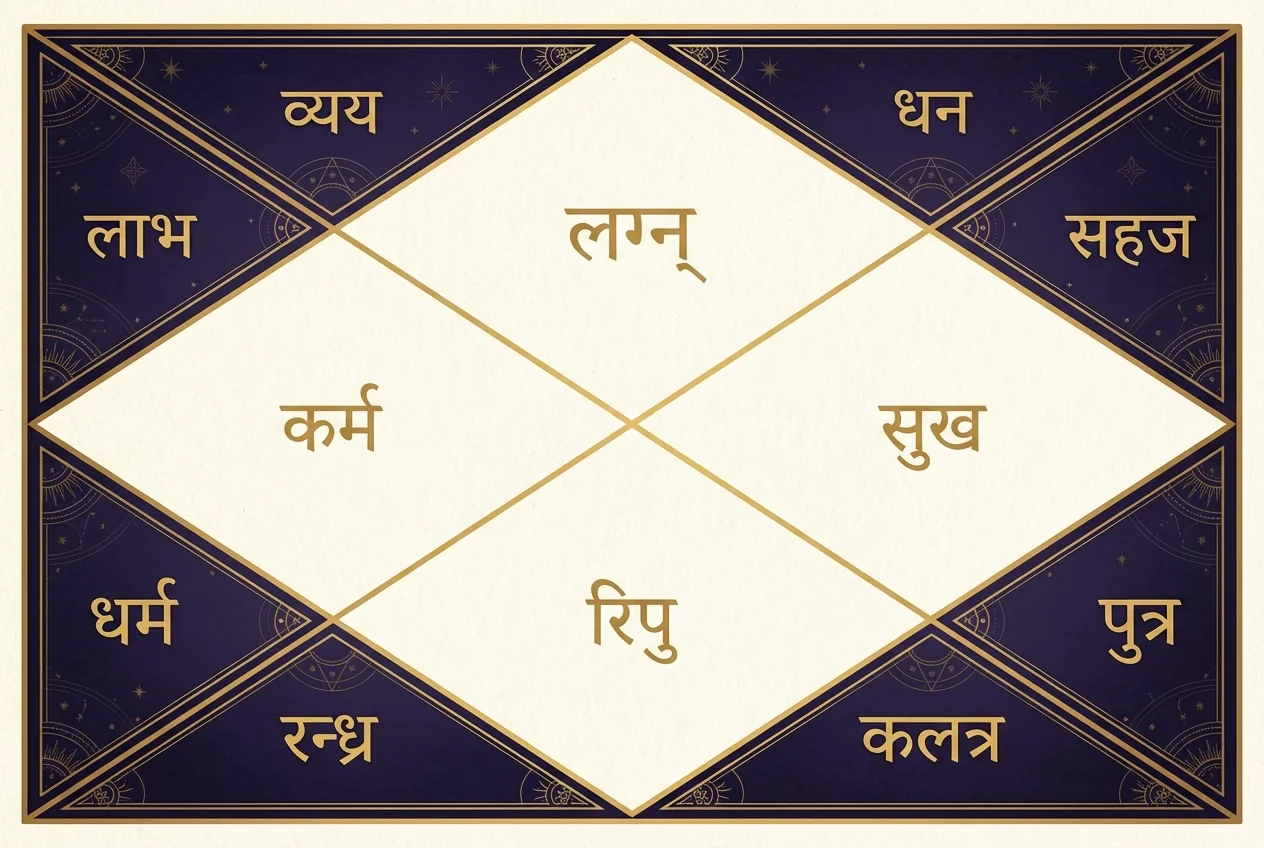
The 12 Bhavas with their Sanskrit names in the traditional North Indian chart format
Lagna Bhava Tanu Bhava - The Self
Life Areas
- Physical body & health
- Personality & temperament
- Self-identity & ego
- Early childhood
- General life direction
Body Parts
- Head & brain
- Face & complexion
- Overall physical frame
Dhana Bhava Wealth House
Life Areas
- Accumulated wealth
- Family (kutumba)
- Speech & voice
- Food & eating habits
- Values & self-worth
Body Parts
- Face, mouth, tongue
- Teeth & gums
- Throat & neck
Sahaja Bhava Siblings & Courage
Life Areas
- Younger siblings
- Courage & mental strength
- Communication & writing
- Short journeys
- Artistic skills
Body Parts
- Shoulders & arms
- Hands & fingers
- Upper chest
Sukha Bhava Happiness & Home
Life Areas
- Mother
- Home & property
- Vehicles
- Emotional happiness
- Education & degrees
Body Parts
- Chest & heart
- Lungs & breast
- Upper stomach
Putra Bhava Children & Creativity
Life Areas
- Children & progeny
- Creative intelligence
- Romance & love
- Speculation & investments
- Past life merit
Body Parts
- Heart (emotional)
- Upper abdomen
- Upper spine
Ripu Bhava Enemies & Health
Life Areas
- Enemies & opponents
- Disease & health issues
- Debts
- Legal disputes
- Daily work & service
Body Parts
- Intestines
- Lower abdomen
- Kidneys
Kalatra Bhava Marriage & Partnerships
Life Areas
- Marriage & spouse
- Business partnerships
- Sexual relationships
- Foreign travel
- Trade & commerce
Body Parts
- Lower back & kidneys
- Reproductive organs
- Urinary system
Randhra Bhava Transformation & Longevity
Life Areas
- Longevity & lifespan
- Transformation
- Inheritance
- Occult sciences
- Hidden matters
Body Parts
- Reproductive organs
- Excretory organs
- Pelvis region
Dharma Bhava Fortune & Spirituality
Life Areas
- Father
- Fortune & luck (bhagya)
- Higher education
- Religion & spirituality
- Long distance travel
Body Parts
- Hips & thighs
- Femur bone
- Sciatic nerve
Karma Bhava Career & Status
Life Areas
- Career & profession
- Fame & reputation
- Status in society
- Government & authority
- Achievements
Body Parts
- Knees
- Bones & skeleton
- Joints
Labha Bhava Gains & Aspirations
Life Areas
- Gains & profits
- Income & cash flow
- Friends & networks
- Elder siblings
- Hopes & wishes
Body Parts
- Calves & shins
- Ankles
- Left ear
Vyaya Bhava Liberation & Losses
Life Areas
- Expenses & losses
- Liberation (moksha)
- Foreign lands
- Isolation & seclusion
- Subconscious mind
Body Parts
- Feet
- Left eye
- Lymphatic system
See Your Complete House Analysis
You now understand the 12 houses. See which planets occupy each house in your personal Vedic chart.
Calculate My Houses Now100% Free • Accurate Sidereal Calculations • Instant Results
Quick Reference Table
| House | Sanskrit | Key Themes | Karaka | Classification |
|---|---|---|---|---|
| 1st | Tanu/Lagna | Self, body, personality | Sun | Kendra, Trikona |
| 2nd | Dhana | Wealth, family, speech | Jupiter | Maraka |
| 3rd | Sahaja | Siblings, courage, skills | Mars | Upachaya |
| 4th | Sukha | Mother, home, happiness | Moon | Kendra |
| 5th | Putra | Children, creativity, romance | Jupiter | Trikona |
| 6th | Ripu/Ari | Enemies, health, service | Mars, Saturn | Dusthana, Upachaya |
| 7th | Kalatra | Marriage, partnerships | Venus | Kendra, Maraka |
| 8th | Randhra | Longevity, transformation | Saturn | Dusthana |
| 9th | Dharma | Fortune, father, spirituality | Jupiter, Sun | Trikona |
| 10th | Karma | Career, status, fame | Sun, Saturn, Mercury | Kendra, Upachaya |
| 11th | Labha | Gains, friends, aspirations | Jupiter | Upachaya |
| 12th | Vyaya | Losses, liberation, foreign | Saturn, Ketu | Dusthana |
The 9 Planets (Grahas) That Occupy the Houses
A house describes an area of life; the planet sitting in it supplies the energy. Vedic astrology uses nine grahas ("that which seizes") — the seven visible bodies plus the two lunar nodes, Rahu and Ketu. Which graha falls in which house is what makes a chart unique.
- Sun (Surya): soul, self-esteem, authority, father, vitality.
- Moon (Chandra): mind, emotions, mother, intuition, public perception.
- Mars (Mangal): energy, courage, drive, siblings, conflict.
- Mercury (Budha): intellect, communication, learning, commerce.
- Jupiter (Guru): wisdom, expansion, fortune, teachers, dharma.
- Venus (Shukra): love, beauty, relationships, comfort, the arts.
- Saturn (Shani): discipline, structure, karma, longevity, hard lessons.
- Rahu (North Node): ambition, obsession, foreign and unconventional pulls (shadow planet).
- Ketu (South Node): detachment, spirituality, past-life karma, letting go (shadow planet).
To read a placement, combine the three: the house (life area), the sign it holds, and the graha occupying it. For example, Saturn in the 10th house (Karma Bhava) points to a career built through discipline and time; Venus in the 7th (Kalatra Bhava) colours marriage and partnership with harmony and attraction. For a deep dive on one house, see our guide to the 10th house and career.
Beyond the Rashi Chart (D1): the Navamsa (D9)
Everything above — the 12 houses, signs and grahas — describes the Rashi chart, also called the D1. It is your whole-life chart and the foundation every other reading builds on. But Vedic astrology also uses divisional charts (vargas): each sign is subdivided and re-mapped to bring one area of life into sharper focus.
The most important of these is the Navamsa, or D9 — each sign split into nine parts of 3°20′. It deepens what the Moon’s nakshatra already hints at, and astrologers read it for three things above all: marriage and the spouse, dharma (life purpose), and the underlying strength and ripening of each planet. A planet occupying the same sign in both the D1 and the D9 is called vargottama — unusually strong. The D9 is often described as the chart of the second half of life.
What our free tool shows
Our free calculator generates your D1 (Rashi) chart — the essential foundation and the chart this guide teaches you to read. Divisional charts like the D9 chart are an advanced, specialist layer that sits beyond a free tool. If you are new to all of this, start with what Vedic astrology is and build up from the D1.
| Aspect | D1 — Rashi chart | D9 — Navamsa |
|---|---|---|
| Covers | The whole life — body, all 12 areas | Marriage, dharma, planetary strength |
| Role | The primary chart everything builds on | A deeper divisional (varga) layer |
| Emphasis | Overall life direction | Partnerships & planetary ripening |
| Availability | Included in the free chart | Advanced / specialist |
Written by
DashaClub Vedic Astrology Team
Our team combines authentic Vedic astrology (Jyotish) methodology with modern computational precision. Every guide on DashaClub is grounded in the Vimshottari Dasha system, sidereal zodiac calculations, and traditional Parashari principles — the same methods used to generate over 50,000 personalized birth charts on our platform.